Once upon a time, there was a P-38 model that never flew. It was built from a Royal kit. I thought it was cool, but not many of them survived for very long. To this day, I have only seen one P-38 model fly ( Wing Mfg ). Several models were considered, mainly the VQ ( Legend ) model and the Ziroli. Other ARF models look like cartoon character versions of the real airplane. The VQ model was going to cost me $900 US just to get it here and the Ziroli is also a huge build that will cost more than I can spend at the moment, by the time you add up all the accessories, landing gear, engines, etc. Not to mention that it would require a new vehicle or a trailer, just to transport the thing.
Enter Col Art Johnson
He was a WW2 veteran who had joined the USAAF in hopes of being able to fly a P-38. Well, he ended up flying everything but and so when he retired, he decided to build a radio control model. The plans for which were published in the June 1978 issue of Model Builder. It's a good size ( 15% scale, or 1.8" to the foot ) and should *just* fit in my car.
Col Art Johnson AMA biography
Also, check out the construction article.
Construction article from June 1978 Model Builder
P-38L-5 44-25319 was destroyed on April 7, 1945 in a mid-air collision. Edmond Schieve was the pilot. The other aircraft involved was P-38 44-25579, piloted by Jerry M Brown. Both aircraft belonged to the 59th FS of the 33rd FG in India.
This model placed fifth in sport scale at the 1977 Nationals at March AFB, in Riverside, California. As a sport scale model, some compromises were made from true scale. The most obvious being the landing gear. The real airplane sat at a 5.5 degree angle nose up, when on the ground, with a 13 degree clearance angle to the tail skids. Scale wheel diameters would be 4" for the nose and 5.5" for the mains, where the plans show 3" and 4" respectively. Art used 90 degree Rhom Air retracts. It's amazing that his airplane weighed only 13 lbs ready to fly, without fuel. Art's airplane also did not have flaps. He didn't know how to make operational Fowler type flaps and left it up to the builder. Although, he could have incorporated a plain or split flap, as Ziroli had done.
For more scale accuracy, the following modifications should be made to the plans
1. Correct wing tip airfoil ( NACA 4412 )
2. Correct aileron span
3. Constant chord flaps of correct span
4. Correct spacing between booms
5. Longer booms and center pod
6. Correct geometry landing gear
7. Span and chord of horizontal stabilizer
Monday, 30 September 2019
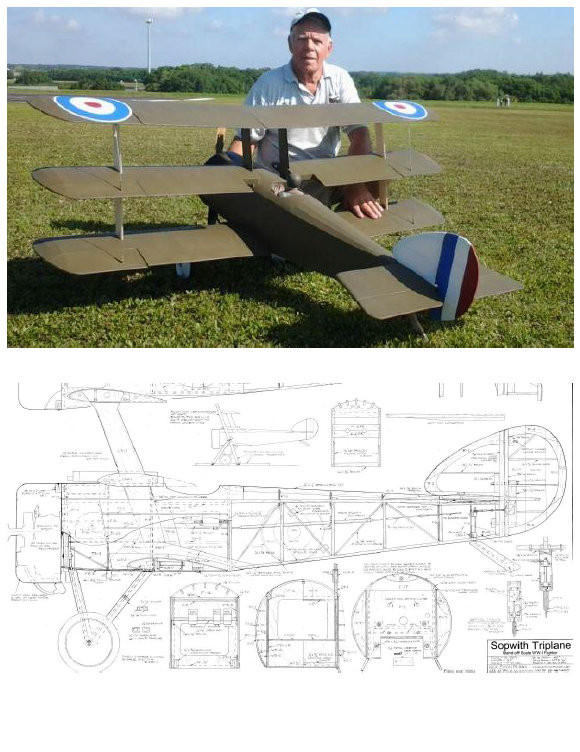
Ziroli Plans Sopwith Triplane Modifications
Image from Ziroli Plans website
If it weren't for the Sopwith Triplane, the Fokker Dr.1 would not have existed. There are far too many of the latter around. Nick Ziroli is more known for his WW2 designs, so his WW1 types are more "standoff scale". For the really discerning builder, there are more accurate plans/kits available.
This model is somewhere between 1/4 and 1/5 scale, depending on which dimensions you are looking at. The choice to call it 1/5 scale is one of marketing, I think. To go head to head with other 1/4 scale offerings is probably not a wise decision. However, when one looks more closely at the plans and takes some measurements, it turns out that the model is much closer to 1/4 scale in all but wingspan.
A 1/4 scale Balsa USA Pup, for example, has a 9 inch cowl, whereas this airplane is 9.25". The tail surfaces are almost exactly 1/4 scale. So, why were the wings clipped? It would seem that the reason is to improve flyability under most conditions by keeping the wing tips out of the dirt and making it easier to fly in wind. It is also heavy, at near 20 lbs, when most 1/4 scale models are around 14 or so. The plan shows a G-38 engine and it still needed 2 lbs of weight in the front of the cowl.
For those who want a WW1 type, but don't want to deal with delicate construction and wire rigging, this triplane might be for you and there are some very simple things that can be done to improve the scale accuracy with very little effort. Simply adding 2 rib bays to each wing panel would increase the span of each wing by 12" and bring the aspect ratio up to where it should be, as well as adding a good 300 sq in to the wing area. That by itself would probably be enough. With a little more effort, one could substitute an aluminum cowl from Balsa USA or Mick Reeves and make it work, while maybe being able to remove some nose weight. Going with larger wheels is also an option. The plan calls for the Dubro 5.6" wheels, but one could upgrade to the William's Bros 6-5/8" or the Dubro 7" wheels. Since the landing gear wire needs to be bent anyway, spreading the wheels apart to a 1/4 scale 16.5" ( They are about 13.5" on the plan ) is not a bad idea either.
Sunday, 9 July 2017
ESM Hawker Hurricane ( 72 inch wingspan )
Back on Sunday, August 13, 2006, I flew the initial test flight of an ESM Hawker Hurricane for a fellow club member. This was the smaller 72" version and had an RCV 90 SP engine, turning an 18 inch prop ( 12" pitch ? ). So, in theory, it should have had the torque of a 1.80 and the thrust of a 1.00. Here are some notes I made of the flight.
It took off smoothly and
didn't jump into the air, even while holding a lot of up elevator. Climb power
was adequate and scale like with the angle as shallow as possible, just to
clear the trees, retracting the gear ASAP to get rid of some drag.
Once it was trimmed ( right rudder and right aileron ), a few photo passes were made and then a climb to a safe altitude for stall tests.
So, flaps up, it stalled at about 1/2 elevator
input with a slight left wing drop. With full flaps, the nose wanted to pitch
down significantly. Without re-trimming, it stalled at about 3/4 up elevator
input with a violent left wing drop that had the plane right upside down! A
little more right rudder trim...
Relaxing back pressure a little and rolling the
wings level, the plane recovered from the dive and the flaps were retracted
again. So, as long as I didn't exceed 3/4 up elevator on the approach, the
speed could be controlled with no danger of a stalI. The engine was
slowly losing power throughout the flight, so instead of attempting any more low
photo passes or barrel rolls and the like, I elected to land it. With the gear
and flaps down, full throttle was needed on the downwind to maintain height
(engine was really bogging now). A curved final approach turn was made, gradually
pulling the throttle off to idle as it passed over the edge of the field. All the elevator was used in the flare. There was no tendency to stall, due to being in ground effect with the power off. The engine had stopped at this point. It landed
softly with the nose slightly high. I would have liked a full 3 pointer, but so
be it!
I had recommended reducing the throw to about 2/3 of what it was and adjusting the elevator up a little bit, so that it would need a lot of down trim to fly level. In this way, it would be more difficult to stall and yet would still have enough up elevator to flare, once it was re-trimmed with the flaps down. We never got around to making another flight as the owner moved away from the area.
I found it interesting that the model had the same stall characteristics as the real airplane. To quote Dan Griffith from the 1999 issue of Flight Journal, "Unlike the Spitfire-but in common with the P-51-the aircraft has only one real vice: a viscious stall in the landing configuration without any noticeable stall warning. One moment you are straight and level; the next, you have stalled and are almost on your back."
Bruce Lockwood said the following in Warbirds ( Volume 22 Number 5 ). " Once on station, I did a clearing turn then slowed to do some stalls - clean and in idle they come at around 63 kt with a nice buffet and easy right wing roll. Very nice. Next was a stall in the landing configuration. At idle power, the break came at around 50 kt with buffet and a sharper left wing drop. Now, with the power on I did the same thing. This time the nose attitude was very high as the airspeed hovered around 45 kt before stalling and sharply dropping the right wing over 90 deg. "
I found it interesting that the model had the same stall characteristics as the real airplane. To quote Dan Griffith from the 1999 issue of Flight Journal, "Unlike the Spitfire-but in common with the P-51-the aircraft has only one real vice: a viscious stall in the landing configuration without any noticeable stall warning. One moment you are straight and level; the next, you have stalled and are almost on your back."
Bruce Lockwood said the following in Warbirds ( Volume 22 Number 5 ). " Once on station, I did a clearing turn then slowed to do some stalls - clean and in idle they come at around 63 kt with a nice buffet and easy right wing roll. Very nice. Next was a stall in the landing configuration. At idle power, the break came at around 50 kt with buffet and a sharper left wing drop. Now, with the power on I did the same thing. This time the nose attitude was very high as the airspeed hovered around 45 kt before stalling and sharply dropping the right wing over 90 deg. "
Wednesday, 5 July 2017
Great Planes Super Chipmunk 1.20 ARF
For scale aerobatics, I decided on the Great Planes Super Chipmunk ( Almost Ready to Fly ).
For the history of this airplane, see the following link to the EAA website, where the real airplane now resides.
Super Chipmunk N1114V
The model is between 1/4 and 1/5 scale ( 21.5% ), with an 81 inch wingspan. To power the model, a Laser 150 fits nicely in the cowl, turning an APC 16 x 8 propeller. The "silencer" is completely enclosed. It currently has 27 oz of lead right in the front of the cowl and it still needs a bit more to balance at the recommended center of gravity.
The all up weight, ready to fly ( without fuel ) is 14 lbs 11 oz as follows,
Wing: 4 lbs 9 oz
Fuselage: 10 lbs 2 oz ( the propeller is 3.5 oz and the 6V, 2000 mAh NiMh battery is 5.3 oz )
The airplane is being flown with a Futaba 7C radio system, with 6 S3003 servos and 1 GWS S03TXF standard servo on the rudder ( 86 oz-in at 6V ).
Planned upgrades include replacing the foam main wheels ( 1.5 oz each ) with Robart scale wheels ( 3.3 oz each ), even though they're covered by wheel pants, and installing an adjustable pitch Solo propeller. The real airplane had an Aeromatic constant speed prop and so the Solo prop with vintage spinner will complete the look and hopefully allow some weight to be removed from the cowl.
Art Scholl was not only an airshow pilot, but was the head of the aeronautics department at San Bernadino Valley College. He was killed while filming for the movie, "Top Gun" in 1985. Coincidentally, that was the same year I started flying radio control planes.
For the history of this airplane, see the following link to the EAA website, where the real airplane now resides.
Super Chipmunk N1114V
The model is between 1/4 and 1/5 scale ( 21.5% ), with an 81 inch wingspan. To power the model, a Laser 150 fits nicely in the cowl, turning an APC 16 x 8 propeller. The "silencer" is completely enclosed. It currently has 27 oz of lead right in the front of the cowl and it still needs a bit more to balance at the recommended center of gravity.
Showing the engine installation and the 27 oz of weight glued to the top of the cowl
Wing: 4 lbs 9 oz
Fuselage: 10 lbs 2 oz ( the propeller is 3.5 oz and the 6V, 2000 mAh NiMh battery is 5.3 oz )
The airplane is being flown with a Futaba 7C radio system, with 6 S3003 servos and 1 GWS S03TXF standard servo on the rudder ( 86 oz-in at 6V ).
Planned upgrades include replacing the foam main wheels ( 1.5 oz each ) with Robart scale wheels ( 3.3 oz each ), even though they're covered by wheel pants, and installing an adjustable pitch Solo propeller. The real airplane had an Aeromatic constant speed prop and so the Solo prop with vintage spinner will complete the look and hopefully allow some weight to be removed from the cowl.
Art Scholl was not only an airshow pilot, but was the head of the aeronautics department at San Bernadino Valley College. He was killed while filming for the movie, "Top Gun" in 1985. Coincidentally, that was the same year I started flying radio control planes.
Wing walk material was added using 150 grit sandpaper
A video my friend Chris made
Saturday, 22 April 2017
Top Flite P-39 ( Gold Edition )
I recently acquired a Gold Edition kit, with retracts, an offer which I couldn't refuse. This kit has been discontinued for awhile now ( 2010? ). The original was designed by Dave Platt for Top Flite, I'm going to guess around 1970-1972. Dave left Top Flite to start his own business.
It had decals for an airplane that served in North Africa with the 93rd Fighter Squadron ( P-39L-1-BE serial 42-4558, "The Pantie Bandit" ).
Then, somewhere around 2000, the Gold Edition hit the market, designed by Ernest J LeClair. He also did the Stinson, Bonanza and DC-3 for Top Flite. Many scale improvements were made. The control surfaces were ribbed, tail surfaces were airfoil shaped, split flaps and retracts were incorporated. The wing used the new Selig airfoils, first introduced on the P-47, if I recall correctly.
This airplane has markings of a J model flown by Leslie Spoonts Jr. in the Aleutians ( Alaska ) with the 57th Fighter Squadron ( serial 41-7073 ). As such, it didn't have the olive drab and tan paint scheme, as shown on the box. Airplanes were painted that way for operations in the Med theatre.
I always thought it would be cool to put the engine behind the cockpit in the model. Well, cooling might be a problem, but it could be done with some modifications. Take the Thompson Trophy racers, for example.
They had an extra scoop under the center section of the wing, which would be ideal for cooling an inverted engine. Likewise, the radiator exit flap was in the center wing trailing edge and so the model would have to be similarly constructed. Then, there's the problem of an extension shaft and how to prevent it from loosening off the propeller shaft. The model will be heavier, due to having to balance the airplane without an engine in the nose and so more power will be needed. I'm thinking an RCV 130 CD might be ideal. I also like that engine for the Sea Fury, being sleeve valved and all, just like the real thing!
Friday, 17 February 2017
Hangar 9 PT-19 1.20
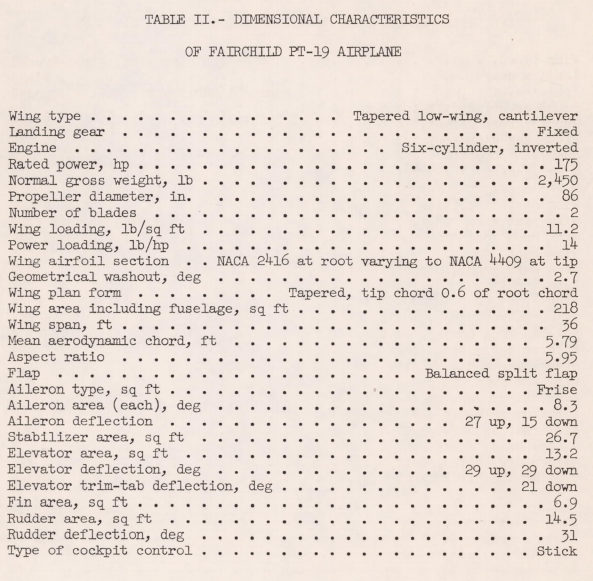
After the Cap 232 crashed and the crankshaft was straightened on the G-23, the engine was installed in a Hangar9 PT-19 ( now discontinued, surprise! ). This model was sold to a club member who had recently earned his wings. One day, it veered to the left on takeoff due to a crosswind and proceeded to the edge of the field. It was pulled off the ground on the ragged edge of a stall. Shortly after, it dropped a wing and cartwheeled into the ground. Being an ARF, it did not use scale airfoils, at least not at the wingtip, which I was sure contributed to the tip stall. I offered to rebuild the wing ( redesign it really ), with correct airfoils and washout. The original model did not have any visible washout, that I could see.
This is where I go off about ARFs and "scale" wing design. Without plans, you don't know how the airplane was designed or constructed. There's a general consensus among modelers that scale airfoils don't work well on models. This is a myth. The real airplane in this case, not only had a higher camber wing section at the tip ( NACA 4409 ), but also had a good 2.7 degrees of washout, from just outside the fairing near the fuselage to the end of the aileron, both of which were not present on the model and would surely make it fly better, not worse!
With some information about the real airplane in hand, the wing was re-designed with 4 degrees of washout and a +1 degree average incidence, so +3 at root centerline to -1 at the theoretical tip. I had the wing ribs laser cut by Martin Rousseau of MR Aerodesign.
It was decided to convert it into a PT-26 Cornell, with enclosed cockpit. My dad was bored and wanted a winter project, so he constructed the wing and canopy. The engine needs to be test run and then hopefully the airplane will fly again this summer, better than before!
Tuesday, 1 December 2015
Sig Mustang 450
My dad had taught himself to fly using a Goldberg Eaglet 50 and the Top Flite Freshman. The Eaglet was rebuilt so many times, we gave it a new name, " The Epoxy ". Anyway, it served its purpose and dad moved on to more adventurous models, like the Blue Max II and this one.
The kit ( RC-28 ) was designed by Hank Pohlmann around 1971 as a replacement for Maxey Hester's Midget 450 ( RC-6 ). It was powered by a Picco 45 with a Perry carb. As my dad tells the story, he built the plane on the ship he was working on and flew it as a guest at Sault Ste Marie. He didn't like the control throws on the aileron, so he doubled them. The plane had never flown and this was to be the test flight. As the plane took off, a wing started to drop, as they always do when they're slightly out of trim. The roll rate was so fast that the plane did a complete 360 degree roll before anyone knew what was happening. Dad pulled up on the elevator and was lucky the plane was right side up. Everyone thought he was some hot shot pilot when really it was the luck of the Irish!
After I got my wings, and was flying the Blue Max, dad would let me fly the Mustang a little bit. It scared the hell out of me. It was snappy and I was afraid of stalling it on landing, which was way too fast for my liking at the time. It did crash a few times, but that foam wing never broke! Many years later, I've aquired a kit and will finish building it. I'm undecided on an engine, since the Picco 45 is no longer available. Maybe I'll put a period K&B in it or something ( Oh, the horror! ).
Plans are available on the Outerzone
Photos taken probably spring 1986
The kit ( RC-28 ) was designed by Hank Pohlmann around 1971 as a replacement for Maxey Hester's Midget 450 ( RC-6 ). It was powered by a Picco 45 with a Perry carb. As my dad tells the story, he built the plane on the ship he was working on and flew it as a guest at Sault Ste Marie. He didn't like the control throws on the aileron, so he doubled them. The plane had never flown and this was to be the test flight. As the plane took off, a wing started to drop, as they always do when they're slightly out of trim. The roll rate was so fast that the plane did a complete 360 degree roll before anyone knew what was happening. Dad pulled up on the elevator and was lucky the plane was right side up. Everyone thought he was some hot shot pilot when really it was the luck of the Irish!
Hank and the Mustang were on the cover of Model Airplane News
After I got my wings, and was flying the Blue Max, dad would let me fly the Mustang a little bit. It scared the hell out of me. It was snappy and I was afraid of stalling it on landing, which was way too fast for my liking at the time. It did crash a few times, but that foam wing never broke! Many years later, I've aquired a kit and will finish building it. I'm undecided on an engine, since the Picco 45 is no longer available. Maybe I'll put a period K&B in it or something ( Oh, the horror! ).
Plans are available on the Outerzone
Subscribe to:
Posts (Atom)