Friday, 17 February 2017

Hangar 9 PT-19 1.20


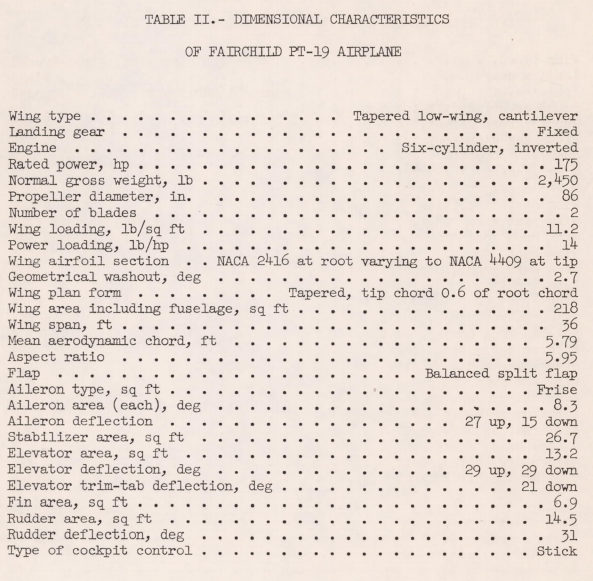
After the Cap 232 crashed and the crankshaft was straightened on the G-23, the engine was installed in a Hangar9 PT-19 ( now discontinued, surprise! ).  This model was sold to a club member who had recently earned his wings.  One day, it veered to the left on takeoff due to a crosswind and proceeded to the edge of the field.  It was pulled off the ground on the ragged edge of a stall.  Shortly after, it dropped a wing and cartwheeled into the ground.  Being an ARF, it did not use scale airfoils, at least not at the wingtip, which I was sure contributed to the tip stall.  I offered to rebuild the wing ( redesign it really ), with correct airfoils and washout.  The original model did not have any visible washout, that I could see.

This is where I go off about ARFs and "scale" wing design.  Without plans, you don't know how the airplane was designed or constructed.  There's a general consensus among modelers that scale airfoils don't work well on models.  This is a myth.  The real airplane in this case, not only had a higher camber wing section at the tip ( NACA 4409 ), but also had a good 2.7 degrees of washout, from just outside the fairing near the fuselage to the end of the aileron, both of which were not present on the model and would surely make it fly better, not worse!  


With some information about the real airplane in hand, the wing was re-designed with 4 degrees of washout and a +1 degree average incidence, so +3 at root centerline to -1 at the theoretical tip.  I had the wing ribs laser cut by Martin Rousseau of MR Aerodesign.
It was decided to convert it into a PT-26 Cornell, with enclosed cockpit.  My dad was bored and wanted a winter project, so he constructed the wing and canopy.  The engine needs to be test run and then hopefully the airplane will fly again this summer, better than before!


Tuesday, 1 December 2015

Sig Mustang 450

My dad had taught himself to fly using a Goldberg Eaglet 50 and the Top Flite Freshman.  The Eaglet was rebuilt so many times, we gave it a new name, " The Epoxy ".  Anyway, it served its purpose and dad moved on to more adventurous models, like the Blue Max II and this one.

Photos taken probably spring 1986

The kit ( RC-28 ) was designed by Hank Pohlmann around 1971 as a replacement for Maxey Hester's Midget 450 ( RC-6 ).  It was powered by a Picco 45 with a Perry carb.  As my dad tells the story, he built the plane on the ship he was working on and flew it as a guest at Sault Ste Marie.  He didn't like the control throws on the aileron, so he doubled them.  The plane had never flown and this was to be the test flight.  As the plane took off, a wing started to drop, as they always do when they're slightly out of trim.  The roll rate was so fast that the plane did a complete 360 degree roll before anyone knew what was happening.  Dad pulled up on the elevator and was lucky the plane was right side up.  Everyone thought he was some hot shot pilot when really it was the luck of the Irish!

Hank and the Mustang were on the cover of Model Airplane News

After I got my wings, and was flying the Blue Max, dad would let me fly the Mustang a little bit.  It scared the hell out of me.  It was snappy and I was afraid of stalling it on landing, which was way too fast for my liking at the time.  It did crash a few times, but that foam wing never broke!  Many years later, I've aquired a kit and will finish building it.  I'm undecided on an engine, since the Picco 45 is no longer available.  Maybe I'll put a period K&B in it or something ( Oh, the horror! ).

Plans are available on the Outerzone

Friday, 20 February 2015

Carl Goldberg Extra 300, Hangar9 Cap 232, Great Planes Giles 202

When I got back from University and started working to pay back the loan, one of the first things I bought was an Extra 300 model that a club member was selling, with an OS 1.20 FS.
I had first flown one of these the previous summer for another member and I really liked how it flew.  Back then, 3D flying was only just starting and wasn't really a thing yet.  So, with this model, I did alot of inverted flight and outside maneuvers as well as learning rolling circles and knife-edge circuits.  I developed one maneuver that freaked people out that you don't see much.  In the middle of a turn from base onto final, at low altitude and with some speed, I would roll 180 degrees and continue the turn inverted, followed by a low inverted pass.  That was my favorite.  Everybody thinks the airplane is going to crash!

The 1.20 was eventually exchanged for the 0.90 in the Corsair and both airplanes were then more "scale like" in their vertical performance.  The Corsair was better, while the Extra was worse ( the real airplane doesn't have unlimited vertical ).

My dad crashed the Extra one day and decided to replace it with the Hangar 9 Cap 232, designed by Dave Patrick ( who also designed the Goldberg Extra 300 ), powered by a Zenoah G-23.

It weighed about 14 lbs and was decidedly underpowered.  Well, one day while dad was flying it, the battery became disconnected in a loop and the plane crashed, bending the crankshaft!  A club member straightened it at which point it was installed into a Hangar 9 PT-19.  So, I had no aerobatic airplane.

I had previously test flown a Midwest Giles 202 ( designed by Mike McConville ) for a club member and it was the most "true" airplane I had ever flown.  I loved it.

Great Planes had an ARF version and I decided to go with that.

I installed the Saito 1.80 and flew it for about two months before suffering an engine exhaust fire and then problems with the cowl fasteners.  Other problems with the Saito included the muffler pressure nipple coming loose and a broken valve spring ( right after takeoff! I was lucky to get the airplane back ).  It didn't fly as well as the Midwest version.  By this time, everybody was flying these scale aerobatic types and 3D style flying was taking over.  I decided to sell the Giles along with the engine ( the valve spring was replaced ) and a new replacement cowl.

Wednesday, 18 February 2015

Sterling Spitfire


The year was 1993.  I was finished high school and going to university ( aerospace engineering ) in the fall.  A club member had brought out this 30 year old Sterling Spitfire and I was to be the test pilot.  I was nervous as hell, because this was an old kit and had never flown.  It had a Super Tiger 56 engine with two glow plugs, if I recall correctly.  Well, it flew and quite nicely at that.  I remember how graceful and smooth it was.  The elevator fluttered such that it was invisible in flight, but control was not affected.  Upon landing, there was no evidence of any damage and the hinges were very strong!  So, we just flew it like that!  It was eventually modified with flaps and retracts, some right thrust was put into it and then it truly looked the part.  It made the most beautiful 3 point landings.  I went to university dreaming about Spitfires!

This airplane was designed by George Harris and was featured in the February 1962 issue of American Modeler.  To this day ( Feb 19, 2015 ), this airplane probably still has the most accurate outline and the best flying qualities of any other 60 size Spitfire ( I have flown both the Pica and Top Flite Gold Edition models ).  It need only be modified for flaps and retracts, if you can find a kit!  It had the same markings as the Monogram 1/48 plastic kit of the same vintage, which makes me wonder if George didn't use that kit to help him design the R/C version.

Plans are available from The Outerzone.

Blue Max and Midwest Hots

It must have been 1985 and my dad decided to build a plane that was featured in the February issue of Model Aviation, called the Blue Max II.


It was basically a 40 size version of Chuck Cunningham's Hooker design ( Oct 1981 RCM, plan 851 ) only it was designed by Jim Allen Jr.  I used it in a fun fly contest in the summer of 1986, I guess.  It was an easy plane to fly, quite aerobatic, but could also fly slow.  Even though I had only just got my wings a few months previous, I didn't have a problem flying this airplane and it was my first introduction to aerobatics.  Anyway, the event in question was the fastest circuit, where the airplane had to cross both boundaries of the field.  I won the event and the prize was a Midwest Hots kit ( designed by Dan Santich )!

It was built during the winter and the following summer, I was asked to fly a demonstration at the Thompson Products company picnic day.  This, I did, using the Hots.  There were pony rides and all kinds of people around.  Something like this wouldn't be considered safe today, I'm sure!  In any case, I flew out of the parking lot, avoiding the light standards on landing.  After about 8 flights, I finally hit the light standard on final approach and it couldn't have been more centered!  It sheared the muffler off the engine and damaged the wing root.  At this point, I remember saying, "Now you've seen all aspects of the hobby!".  Whenever I drive by that parking lot today, I wonder how I ever did such a thing!

Plans for the Blue Max II are available from the AMA plans service ( 00465 ).
The Hots is featured in Model Airplane News ( April 1984 )

Sig 1/6 clipped wing Cub and Citabria


Originally a Chuck Hollinger design ( Jan 1955 Air Trails ), I received a kit for Christmas ( 1987 ) or my birthday ( 1988 ), can't remember which.  I do remember sitting in class, reading model airplane magazines.  One of the planes that I really wanted, was not the Cub, but the Sig Citabria.  In any case, I tried to get the shop teacher to let me build the kit as my wood working project.  He had flown a real Cub, but he didn't go for it.  So, instead, I built a flight box.  Throughout high school, I flew this Cub.  It would fly for 45 minutes on a tank of fuel.  One day, I was doing touch and gos.  There was a senior club member who was waiting for the channel ( we used 72 Mhz back then ), unbeknownst to me.  Well, I guess he got frustrated and decided to "shoot me down" as I turned on to base ( this was the same guy that used to drive me to the meetings before I had a driver's licence and also one of the instructors who awarded me my wings! ).  The plane went out of control and spun into a heavily wooded area.  This other member had a big grin on his face when he said, "you finally lost one, eh?".  The Cub was found hanging in a tree, only lightly damaged, mostly to the wing.  So, it was rebuilt with a full span wing and sold to another club member.

Others witnessed the event and I guess word got back to Don Prentice, who must have felt sorry for me, because he gave me a Sig Citabria that he had built 20 years before, the same year I was born!
I proceeded to fly the Citabria for a few years and it doubled as a float plane.  It had a Webra 61 blackhead for an engine.


I don't have any photos of the model, but it was cream coloured, not unlike this one,

  It was originally designed by Maxey Hester with a symmetrical wing ( as pictured above ).  Then, they redesigned it with the proper NACA 4412 airfoil because of stall characteristics ( so they said ).

The irony here is that the airplane pictured on the box ( N9020L ) was actually a Decathlon ( Bellanca 8KCAB ) with a symmetrical wing! ( NACA 1412, not quite symmetrical, but close enough! ).

The real airplane crashed on Feb 18, 1971 and the pilot was killed.  Sig finally settled on the scheme we see today.


This plane did beautiful flat spins, with a little opposite aileron.  It took a good 3 turns to recover after centering the controls!  Well, one day, one of the wing struts let go and the wing folded just after takeoff, going into the first ( gentle ) turn.  Of course, Don witnessed the incident!  The engine went into another float plane ( a modified Bud Barkley Cessna 152 trainer ), which crashed when the elevator linkage failed.  The engine/firewall detached and sank to the bottom of the lake at Chippawa Creek Conservation Area, where the club used to have the float fly events.

Tuesday, 24 June 2014

Sig Komander


What is there to say about the Sig Komander?  I guess it came on the scene around 1974, just after the Kadet Mk.1.  It was supposed to be an aileron trainer, whereas the Kadet was 3 channel, but eventually had an aileron version as well.  Once the Kadet Mk.II came out with ailerons, the Komander was called an "Intermediate" trainer.  I remember in the early '90s, I had only been instructing for maybe 3 years or so and nobody wanted to teach a particular student with a Komander.  They all cautioned him that it really wasn't a trainer and he should try something slower.  He insisted and so I volunteered to be his instructor.  This airplane really grew on me and helped me to develop a flying technique and method of teaching that I have used ever since.  That student got his wings with only one minor landing incident ( the plane was back out the next day ).  That was the only Komander I have ever seen and unfortunately, it has now been discontinued and is an endangered species.  I'm on a mission to find a kit and document the design, so it may be re-created by anyone with an interest.  Claude McCullough really designed a great looking sport model, with unique but attractive lines and proportions.

So far, I've collected the instructions for the Mk.1 and Mk.II, as well as the partial plan for the Mk.II, which shows the full fuselage top view and the side view, only to the back of the wing.  There are some full size templates in the instruction booklet.  I have confirmed that the airfoil was a NACA 2414 with +0.5 deg incidence.  1 degree of washout was built into the foam cores ( the trailing edge was up 1/8" at the wingtip ).  The stabilizer was set to 0 incidence.  Dihedral is 2-1/4" under each wing tip ( approximately 4 degrees ).

For the Mk.1, the CG was 2" from the LE at the tip to start, moving back to about 2-1/2" for deliberate snap rolls and spins.  Recommended control movements were 1/2" for rudder, 3/8" for elevator and 1/8" to 3/16" for ailerons.

The Mk.2 was different, with a recommended CG of 1-3/4" to start, moving back to 2-1/4" for full aerobatics.  The control throws were recommended as 7/16" for elevator, 5/16" for aileron and 5/8" for rudder.

The main differences between the Mk.I and Mk.II were in the fuselage structure.  In the original model, the firewall was two pieces of 1/8" ply laminated together.  The fuselage top and bottom were 3/32" balsa ( also the sides? ).  In the Mk.II, the fuselage sides, top and bottom are 1/8" balsa, while forward fuselage bottom is 1/8" ply and the firewall is two pieces of 3/32" ply.  The forward fuselage is doubled inside with 1/8" ply, as opposed to 1/4" balsa in the Mk.I.  With the Mk.I, the wing was bolted on with either 1 or 2 dowels or rubber bands, while the Mk.II is bolted on with two forward dowel pins.  The Mk.II used easy hinges for the control surfaces, whereas the Mk.I used nylon ( poly hinges ).  The metal landing gear straps were replaced with nylon in the Mk.II.

Other details of the design include landing gear covers made from 0.030" plastic, 3/4" triangle stock to reinforce the firewall and tail surfaces ( fin and stab ) made from 1/4" balsa sheet.  The rudder has an 8.5 degree forward rake to it, with the hinge line measuring exactly 7-1/4".  The stabilizer spans 22" and is made up of two sheets glued together.  The forward sheet is tapered to a chord of 5-1/4" at the fuselage.  The elevator and rudder are made of 1/4" x 2" elevator/aileron stock.

The airplane was flown with a 0.40, 0.45 and 0.50 sized engines.  Anything greater than a 0.50, they recommended installing a spar in the foam wing.  The instructions show the installation of a Fox 0.45.  There was no right or down thrust built in.

Bill of Materials

Replacement foam wings from Eureka Aircraft ( part# W790 )
Cowl from Fiberglass Specialties ( part# SK-23 )
Canopy from Park Flyer Plastics

1/16 x 3 x 36 ( 14 ) balsa wing sheeting ( SIGB143 )
1/4 x 3/4 x 36 ( 2 ) balsa leading edge ( SIGB034 )
1/4 x 1/2 x 36 ( 2 ) balsa trailing edge ( SIGB033 )
1/4 x 1 x 36 ( 2 ) aileron stock ( SIGB441 )
1 x 1-1/4" x 8 ( 2 ) balsa block wing tips, available as 1" x 3" x 12" ( 1 ) block ( SIGB307 )
1/4 x 2" x 36" elevator and rudder ( SIGB443 )
1/8" x 12" x 12" lite ply hatch parts and fuselage bottom ( SIGPW064 )
3/32" x 12" x 12" plywood fuselage formers ( SIGPW010 )

3" main wheels ( 2 )
2-1/4" nose wheel ( 1 )
Nose Gear ( SIGSH603 )
3/8 x 3/4 x 6" ( 2 ) landing gear blocks, 5/32" groove ( SIGSH125 )
Landing gear retaining straps ( SIGSH131 )
2-1/4" spinner ( Goldberg )
Sullivan 10 oz RST fuel tank ( S428 )
Sig Poly Hinges ( SIGSH543 ) or Easy hinges ( SIGSH710 )
Strip Aileron Horn Set ( SIGSH594 )